What Is Aluminum Extrusion and How Does It Work?

Time:2026-10-27 Author:Charlotte
0%

Aluminum Extrusion is a manufacturing process that shapes heated aluminum through a designed die. The method resembles squeezing toothpaste through a narrow opening. However, industrial extrusion demands precise control of temperature, pressure, speed, and alloy selection. A solid aluminum billet enters the press after controlled heating. A powerful ram then pushes it through the die opening. The emerging profile may resemble a window frame, heat sink, rail, or structural channel.

The process begins with engineering decisions, not the press itself. Designers consider load requirements, wall thickness, corner radii, surface finish, and expected operating conditions. Common alloys behave differently during extrusion. Some provide higher strength, while others offer improved corrosion resistance or better surface appearance. The die also affects production speed and dimensional accuracy. Small design changes can reduce waste and prevent weak sections.

Cooling follows extrusion, often with air or water, depending on the alloy and profile. The material may then be stretched, cut, aged, machined, or finished. Quality teams inspect dimensions, straightness, hardness, and surface defects. Practical experience shows that a successful profile is rarely achieved by guesswork. It requires testing and adjustment. It is not magic. Even reliable equipment can produce inconsistent results when billet temperature or die wear is overlooked. This guide explains how Aluminum Extrusion works, why each stage matters, and where production decisions can influence performance, cost, and long-term reliability. The details matter.
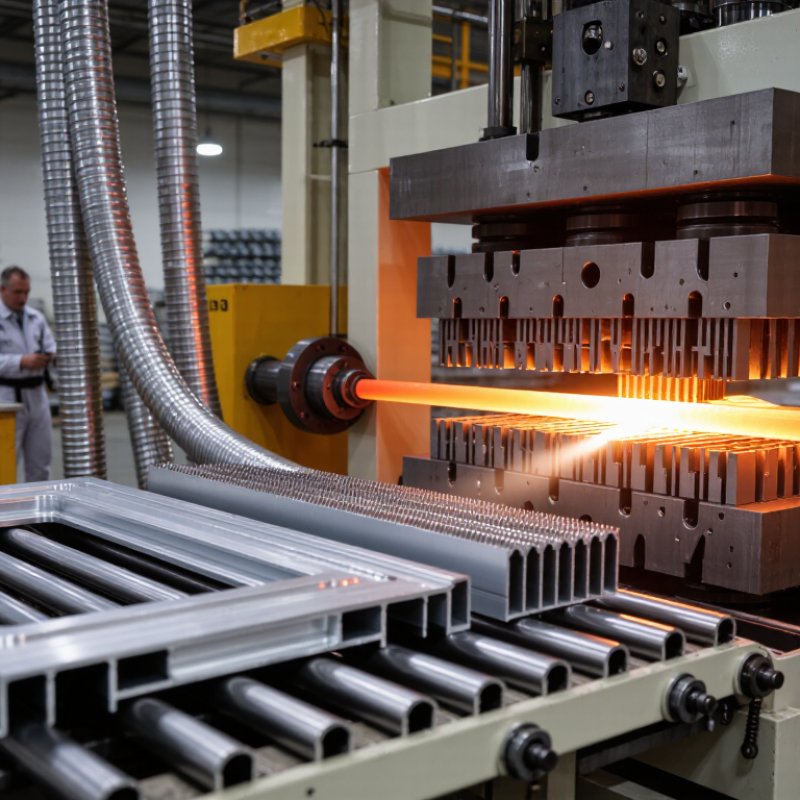
What Is Aluminum Extrusion and How Does It Work?

What Aluminum Extrusion Means and Why It Is Used

Aluminum extrusion is a manufacturing process that shapes heated aluminum through a designed opening called a die. The die controls the profile’s final form. This method can produce channels, frames, rails, heat sinks, and other long components with consistent dimensions.

What aluminum extrusion means is more than pushing metal through a pattern. It combines material behavior, die design, temperature control, and careful inspection. Manufacturers use it because aluminum is lightweight, corrosion resistant, and relatively easy to machine. Extrusion also creates strong shapes with less material waste than many cutting methods. A hollow frame, for example, can provide useful stiffness without becoming unnecessarily heavy. It supports practical designs in construction, transport, electronics, and renewable energy equipment. However, extrusion is not ideal for every part. Very complex shapes may require secondary machining, and poor temperature control can cause bending or surface defects. Engineers must check strength, tolerances, finish, and production volume before choosing it.

Tips: Start with the function, not the appearance. Keep wall thickness as even as possible. Avoid sharp internal corners, which can complicate die production. Ask for test samples when tolerances matter. Measure critical areas after cooling, because aluminum can change slightly during the process. A design may look efficient on paper, yet perform poorly in real assembly. Reviewing that gap early saves material, time, and repeated tooling costs.

The Main Parts and Materials in an Extrusion System

What Is Aluminum Extrusion and How Does It Work?

An aluminum extrusion system turns a heated billet into a continuous profile. The billet is usually an aluminum alloy selected for strength, corrosion resistance, or surface quality. Common choices include 6063 for smooth architectural shapes and 6061 for stronger components.

The main parts work under tight pressure. A hydraulic ram pushes the billet through a hardened steel die. The container holds the billet and limits heat loss during pressing. The die opening controls the profile’s final shape, including walls, channels, and hollow sections. After leaving the die, the hot profile travels across a runout table. A cooling system, puller, and precision saw then help control length and straightness. Later, heat treatment may improve mechanical performance. Small temperature changes can still affect the result.

Tips:

Check billet temperature, die condition, and press speed together. A stable process usually produces cleaner surfaces and fewer dimensional changes. Measure the profile at several points, not just near the cut end. This matters. In practical production, operators often adjust cooling or speed when thin sections begin to twist. That response requires experience, but it should also follow recorded inspection data. It is tempting to blame the die immediately. Sometimes the real issue is uneven cooling, poor alignment, or an alloy that was selected too quickly.

How Aluminum Billets Are Heated and Prepared

Aluminum extrusion begins with a billet, a solid cylinder of cast aluminum. Its preparation strongly affects surface quality, press force, and final dimensions. Operators first verify alloy chemistry, diameter, weight, and casting condition. The U.S. Department of Energy’s Aluminum Industry Technology Roadmap identifies billet heating as a significant energy-use stage in extrusion. That makes temperature control both a quality issue and an efficiency issue.

Billets are commonly heated between 400°C and 500°C, depending on alloy and profile complexity. ASM Handbook guidance places many aluminum extrusion operations within this hot-working range. The billet should feel uniformly heated, not merely hot on its outer skin. Uneven heating can create excessive press loads, tearing, or inconsistent metal flow. Infrared sensors and furnace thermocouples help operators monitor the process, although measurements can still drift near the billet surface. This is where practical experience matters.

Too much heat is dangerous for quality.

Before pressing, workers inspect the billet for cracks, segregation, and heavy oxide. They may remove a short section from the cast end or use homogenization to improve chemical uniformity. Homogenization often occurs near 500°C to 600°C, followed by controlled cooling. The exact cycle depends on alloy composition and casting history. Industry data from the International Aluminium Institute shows that energy efficiency remains a major concern across aluminum production, but billet preparation is sometimes treated too simply. A cleaner process still needs better measurement, not assumptions.

How Pressure Shapes Aluminum Through a Die

What Is Aluminum Extrusion and How Does It Work?

Aluminum extrusion begins with a heated billet, usually around 400–500°C. A hydraulic ram pushes the billet against a shaped steel die. Pressure forces the softened metal through the die opening. The emerging profile keeps that cross-section, whether it forms a window frame, heat sink, or structural rail.

In direct extrusion, the billet and ram move in the same direction. Friction raises the required force, but it also helps maintain steady metal flow. After leaving the die, the profile is cooled, stretched, and cut to length. Small changes in temperature can alter surface quality and dimensional accuracy. This is where practical experience matters. A perfect drawing does not guarantee a perfect extrusion.

The International Aluminium Institute reported global primary aluminium production above 70 million tonnes in 2023. Its technical data also indicates that recycled aluminium requires roughly 5% of the energy used for primary production. That matters when engineers design profiles for efficient material use. Still, “lighter” is not always better. Thin walls may reduce weight but increase distortion, twisting, or die wear.

Tips: Keep wall thicknesses as consistent as possible. Avoid sharp internal corners; generous radii improve metal flow. Check the alloy, billet temperature, and exit speed together. One variable rarely explains every defect. Engineers sometimes adjust only the press speed, and that can be an incomplete solution. Evaluate the whole process.

What Is Aluminum Extrusion and How Does It Work? - How Pressure Shapes Aluminum Through a Die

Process Stage What Happens Typical Temperature or Condition Key Equipment or Tool Primary Output Important Control Factor
1. Billet Preparation A cylindrical aluminum billet is cut to the required length and inspected for surface defects or contamination. Room temperature before heating Billet saw, inspection equipment A correctly sized billet ready for heating Billet alloy, diameter, length, and cleanliness
2. Billet Heating The billet is heated to reduce its resistance to deformation while maintaining suitable material properties. Typically about 400–500°C, depending on alloy and process Gas or electric billet furnace Uniformly heated billet Temperature uniformity and prevention of overheating
3. Die Preparation A steel die with the desired cross-sectional opening is preheated and installed in the extrusion press. Die temperature is commonly controlled near the hot-working range Extrusion die, die oven, die holder Aligned die ready to shape the aluminum Die geometry, bearing length, alignment, and surface condition
4. Loading The heated billet is placed into the container in front of the die. Billet remains hot during transfer Billet loader, press container Billet positioned on the extrusion axis Transfer time, alignment, and container temperature
5. Pressing Through the Die A ram applies high compressive force, forcing the softened aluminum to flow through the die opening. Hot extrusion under high compressive pressure Hydraulic extrusion press and ram Continuous profile with the die-defined cross-section Ram speed, extrusion ratio, billet temperature, and press force
6. Profile Cooling The emerging profile is supported and cooled to stabilize its dimensions and metallurgical condition. Cooling rate varies with alloy, section size, and temper requirements Run-out table, air fans, water or mist cooling Dimensionally stable extruded profile Cooling uniformity and distortion control
7. Stretch Straightening The profile may be lightly stretched to remove bow, twist, and residual stress. Usually performed after cooling and before final cutting Stretching machine Straighter profile with improved dimensional consistency Stretch percentage, gripping force, and profile geometry
8. Cutting to Length The continuous extrusion is cut into specified lengths for handling, heat treatment, or fabrication. Ambient or controlled shop temperature Precision saw Individual profile lengths Cut length tolerance, saw alignment, and burr control
9. Heat Treatment Heat-treatable alloys may be solution heat treated and artificially aged to increase strength. Conditions depend strongly on alloy and required temper Solution furnace, quench system, aging furnace Specified mechanical properties and temper condition Heating schedule, quench delay, cooling rate, and aging cycle
10. Finishing and Inspection Profiles may be anodized, painted, machined, or fabricated, followed by dimensional and surface inspection. Finishing conditions depend on the selected treatment Finishing line, measuring tools, surface inspection equipment Finished aluminum extrusion meeting the design requirements Surface quality, dimensional tolerance, color, and coating thickness

How Extruded Profiles Are Cooled, Cut, and Finished

After aluminum is pushed through a shaped die, the emerging profile is hot, flexible, and slightly unstable. Controlled cooling gives it enough strength for handling without creating unnecessary distortion. Air fans often cool simple sections, while water sprays or mist systems remove heat faster from thicker areas. The cooling rate must remain balanced. Too much cooling on one side can cause bowing or twisting.

Once the profile reaches a workable temperature, operators use a puller to maintain steady movement. A stretching unit then corrects minor bends and internal stress. This step looks simple, but small adjustments matter. A profile may appear straight at one point and curve after cutting. Technicians usually check dimensions with gauges and measuring equipment before the automatic saw begins its work. The saw cuts fixed lengths with clean, square ends, while chips and heat must be controlled.

Finishing depends on the required application. Profiles may receive deburring, brushing, anodizing, powder coating, or machining. Deburring removes sharp edges that could affect assembly or handling. Surface treatment improves appearance and can increase resistance to wear or corrosion. However, finishing cannot repair poor extrusion control. Inspectors check wall thickness, length, straightness, surface marks, and color consistency. In real production, not every defect is obvious immediately. A faint line under the surface may appear only after coating, which is why process records and repeated inspections remain important.

What Is Aluminum Extrusion and How Does It Work?

Representative temperatures across the aluminum extrusion process, from billet heating through cooling and artificial aging. Actual settings vary by alloy, profile size, and production speed.

Aluminum billets are commonly heated to approximately 400–500°C before extrusion. The profile exits the die at a higher temperature, is rapidly cooled by air or water mist, then may be artificially aged at approximately 160–200°C to develop the required mechanical properties.

FAQS

What is aluminum extrusion?

It shapes heated aluminum by pushing it through a designed steel opening called a die.

Why is aluminum extrusion widely used?

Aluminum is lightweight, corrosion resistant, and relatively easy to machine.

What products can extrusion create?

It can produce channels, frames, rails, heat sinks, and structural profiles.

How does the extrusion process work?

A hydraulic ram pushes a heated billet through a hardened steel die.

How hot is aluminum during extrusion?

The billet is commonly heated to about 400–500°C.

Which materials are commonly used?

Aluminum alloys are selected for strength, corrosion resistance, or surface quality.

What design features improve extrusion results?

Keep wall thickness as even as possible.

Can aluminum extrusion create every shape?

No. Very complex shapes may need secondary machining.

How can manufacturers reduce extrusion defects?

Check billet temperature, die condition, press speed, cooling, and alignment together.

What should engineers check before choosing extrusion?

Review strength, tolerances, surface finish, production volume, and assembly conditions.

Conclusion

Aluminum Extrusion is a manufacturing process that turns heated aluminum billets into continuous profiles with precise shapes and dimensions. It is widely used because aluminum is lightweight, corrosion-resistant, recyclable, and easy to form, making it suitable for construction, transportation, electronics, and many industrial applications. An extrusion system typically includes a billet heater, container, ram, die, cooling equipment, cutting tools, and finishing stations. Together, these components control the material from preparation through final production.

Before extrusion, aluminum billets are heated to a carefully controlled temperature so they become soft and workable without melting. A powerful ram then pushes the billet through a shaped die, forcing the metal to emerge as a long profile that matches the die opening. After leaving the die, the profile is cooled with air or water, straightened if necessary, and cut into specified lengths. Additional finishing steps, such as surface treatment or machining, may be used to improve appearance, accuracy, and performance.


Charlotte

Charlotte

Charlotte is a seasoned marketing professional with a deep understanding of the company's portfolio and a passion for elevating its presence in the market. With a keen eye for detail and a commitment to excellence, she ensures that our professional blog is regularly updated with insightful articles......