An Aluminum Extruder transforms heated aluminum billets into precise profiles for construction, transportation, electronics, and industrial equipment. The machine applies controlled pressure, pushing softened aluminum through a shaped steel die. The result may be a window frame, heat sink, rail, or complex structural section.
T. Sheppard, a respected authority on aluminum extrusion technology, explains the principle clearly: “Aluminum extrusion is a process of forcing a billet through a die.” This simple action involves demanding engineering decisions. Operators must control billet temperature, ram speed, die design, lubrication, cooling, and puller tension. Small changes can affect surface quality, dimensional accuracy, and mechanical performance.
The process starts with a billet cut to length and heated within a carefully controlled range. It then enters the container, where the ram pushes it toward the die. The emerging profile is cooled, stretched, cut, and sometimes aged to improve strength. Direct extrusion is widely used, although indirect methods can reduce friction in selected applications.
A clean profile is not guaranteed.
Experienced teams inspect die wear, temperature records, and profile dimensions throughout production. They also check for tearing, distortion, die lines, and uneven cooling. No single setting works for every alloy or shape. That is where practical judgment matters. A production chart may look precise, yet real billets can behave differently from one batch to another. Understanding how an Aluminum Extruder works therefore requires both technical knowledge and careful observation on the factory floor.
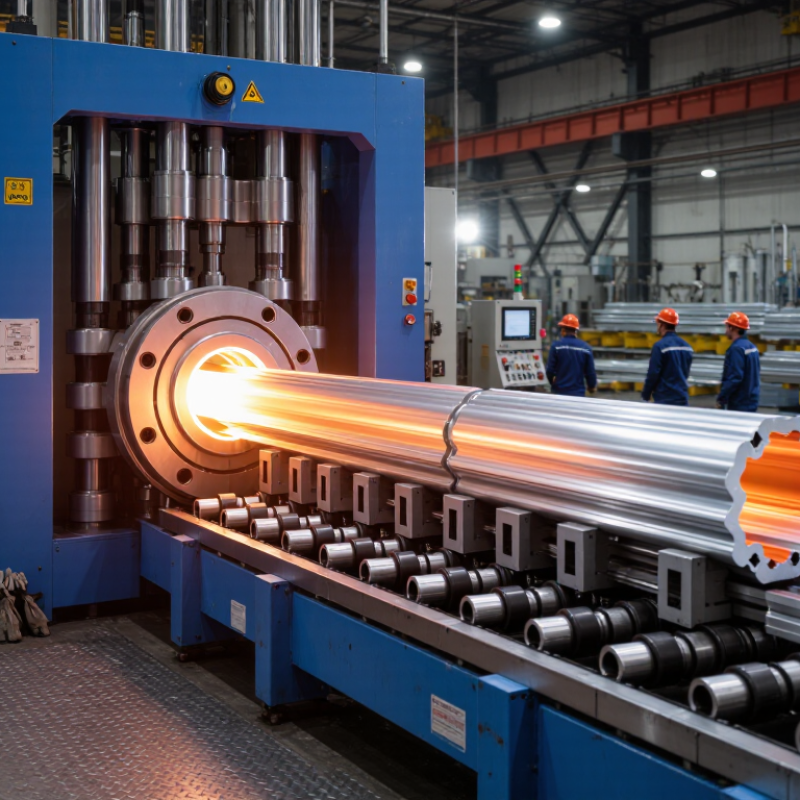
An aluminum extruder is a machine that shapes heated aluminum into continuous profiles. It pushes a cylindrical billet through a steel die under controlled pressure. The die opening determines the final cross-section. A simple opening can produce a flat bar, while a complex one can form channels, tubes, window frames, rails, or heat sinks. The process usually includes billet heating, extrusion, cooling, stretching, cutting, and artificial aging.
The machine does more than make straight metal lengths. It produces lightweight components for construction, transport, furniture, electronics, and industrial equipment. Engineers can design hollow sections, grooves, and reinforcing ribs within one profile. This reduces assembly work and material waste. However, results depend on billet temperature, extrusion speed, die condition, and cooling control. Even careful settings cannot remove every variation. A profile may look simple, yet its performance depends on precise dimensions and consistent alloy properties.
Tips: Check the required profile dimensions before selecting a die. Ask for alloy, temper, length, and surface requirements in writing. Inspect sample pieces for twisting, scratches, uneven walls, and weak corners. Small defects can become expensive problems after cutting or assembly. When testing a new design, leave room for adjustment. Real production is rarely as perfect as the drawing.
An aluminum extruder transforms heated billets into continuous profiles with controlled pressure and speed. The machine begins with a billet loader and a heating furnace. The furnace softens aluminum evenly, but overheating can weaken the profile and damage the die.
Inside the press, the container holds the billet while the ram pushes it forward. The die shapes the metal as it exits. Die holders must stay aligned because small movement can create uneven walls or surface marks. Hydraulic cylinders provide pressing force, while sensors monitor pressure, temperature, and ram speed. A control system records these readings for quality checks. Real production is less tidy than diagrams. I still inspect die wear and temperature changes manually, because sensors can drift.
Tips: Keep the billet temperature consistent, clean the container regularly, and check die alignment before pressing. Watch the first profile closely. It often reveals problems early. After extrusion, a puller maintains profile tension, and a cooling table reduces heat without sudden distortion. A saw then cuts the profile to the required length. Some lines include stretching equipment to correct mild bends. This step is easy to underestimate. Poor tension control may leave accurate-looking pieces with hidden dimensional errors. Regular maintenance, documented settings, and trained operators make the process more reliable.
An aluminum extruder begins with a solid billet, usually a short, cylindrical piece of aluminum alloy. The billet is inspected for cracks, dents, and surface contamination before production begins. It is then cut to a measured length for the planned extrusion cycle. Small errors matter here. An uneven cut can affect pressure and metal flow.
The billet is heated in a furnace or by induction equipment, commonly to about 400–500°C, depending on the alloy and profile. It must become soft enough to flow without melting. Aluminum melts near 660°C, so temperature control requires constant attention. Operators check surface readings and, when possible, compare them with internal temperature data. A billet may look ready outside while remaining cooler inside. That difference can create inconsistent extrusion results.
Before pressing, the heated billet may receive a light surface treatment, while the container, die, and tooling are preheated to reduce sudden heat loss. The billet then enters the container, where a hydraulic ram pushes it through the die opening. In practical production, heating is rarely perfectly uniform. Furnace placement, billet size, and timing can change the result. Experienced operators adjust the cycle after reviewing temperature records and surface quality, rather than trusting one reading. The preparation stage seems simple, but it strongly influences strength, finish, dimensional accuracy, and the stability of the final aluminum profile.
Representative temperature ranges for a typical aluminum extrusion process. Actual settings vary with alloy, billet size, extrusion speed, and equipment.
Aluminum billets are first inspected and stored near room temperature, then heated in a billet furnace until they reach a temperature suitable for extrusion. The die and container are also preheated to reduce heat loss and support a stable metal flow through the die.
What Is an Aluminum Extruder and How Does It Work?
How Pressure Shapes Aluminum Through a Die
An aluminum extruder turns a heated billet into a continuous profile. The billet enters a strong container, while a hydraulic ram pushes it toward a die. Pressure forces the softened metal through the die opening. The emerging shape may resemble a window frame, rail, or heat sink.
Temperature matters greatly. Many common aluminum alloys are extruded near 400–500°C, depending on alloy and profile complexity. The ram must overcome friction, billet resistance, and die deformation. Higher extrusion ratios usually require greater force and tighter process control. A small temperature change can alter surface quality.
The die does more than cut metal. Its bearing length controls flow speed and helps balance thin and thick sections. If one region moves faster, the profile can twist or exit with uneven dimensions. Operators often adjust billet temperature, ram speed, and cooling conditions. This is where practical experience matters.
The International Aluminium Institute reported global primary aluminum production above 70 million tonnes in recent annual statistics. That scale supports extensive demand for efficient forming processes. The U.S. Geological Survey also identifies aluminum as a major industrial material with substantial recycling activity. Recycled feedstock can behave differently during extrusion, however. Assuming identical settings is a mistake. Real production still needs measurement, testing, and occasional correction.
| Process Dimension | Typical Data or Range | How It Affects the Process |
|---|---|---|
| Basic Process | Direct hot extrusion is the most common method for producing aluminum profiles. | A heated billet is pushed through a stationary die, causing the metal to flow through the die opening and take its shape. |
| Primary Equipment | Hydraulic press, billet heater, extrusion container, stem, die, run-out table, puller, and aging furnace. | The press generates force, while the die controls the final cross-sectional geometry of the extruded product. |
| Common Aluminum Alloys | 6xxx-series alloys are widely used for general structural, architectural, and transportation profiles. | These alloys offer a practical balance of extrudability, strength, corrosion resistance, and heat-treat response. |
| Billet Temperature | Approximately 400–500 °C (752–932 °F), depending on alloy, billet size, and profile complexity. | Heating reduces flow stress and allows the billet to pass through the die. Excessive temperature can increase surface defects and die wear. |
| Die Temperature | Typically about 400–500 °C (752–932 °F) before production begins. | Preheating helps maintain stable metal flow and reduces thermal shock when the hot billet contacts the die. |
| Extrusion Pressure | Often in the range of approximately 100–500 MPa, depending on alloy, temperature, profile design, and extrusion ratio. | Pressure must overcome billet deformation resistance and friction at the container and die. Narrow openings and complex shapes generally require more pressure. |
| Extrusion Ratio | Commonly about 10:1 to 100:1 for aluminum profiles; the practical value depends on the alloy and product geometry. | The ratio is calculated as billet cross-sectional area divided by profile cross-sectional area. Higher ratios create greater deformation and usually require more force. |
| Ram Speed | Often approximately 1–20 mm/s for direct extrusion, with the selected speed varying by alloy and profile. | Higher speed increases productivity but also raises deformation heat and the risk of surface tearing, pickup, or dimensional instability. |
| Die Function | Solid dies produce simple profiles; hollow and semi-hollow dies use bridges, ports, and mandrels. | The die divides and guides the aluminum flow before the streams weld together inside the die and exit as a continuous profile. |
| Metal Flow Direction | In direct extrusion, the billet and extruded profile move in the same direction as the ram. | Relative movement between the billet and container creates friction, which increases the required press force compared with indirect extrusion. |
| Profile Exit Temperature | Frequently controlled near 480–570 °C (896–1,058 °F) for heat-treatable aluminum alloys, depending on alloy and process design. | The exit temperature influences surface quality, metallurgical properties, quench requirements, and the final temper. |
| Cooling Method | Air cooling, water mist, or controlled water quenching may be used after the profile exits the die. | Cooling rate affects precipitation behavior, mechanical properties, distortion, and the ability to achieve the intended temper. |
| Typical Dimensional Control | Profile tolerances commonly range from approximately ±0.10 to ±0.50 mm, depending on size, geometry, alloy, and applicable standards. | Die design, press stability, temperature control, and straightening all influence dimensional accuracy. |
| Post-Extrusion Operations | Stretch straightening, sawing, artificial aging, machining, anodizing, or powder coating may follow extrusion. | These operations improve straightness, strength, surface appearance, cut length, and functional performance. |
| Key Quality Risks | Surface tearing, die lines, pick-up, blistering, distortion, incomplete welding, and dimensional variation. | Stable billet temperature, controlled ram speed, suitable die geometry, adequate lubrication practices, and consistent cooling help reduce defects. |
Note: The values shown are general industrial ranges. Actual operating conditions vary with alloy composition, billet diameter, profile geometry, die design, equipment capacity, and applicable production standards.
An aluminum extruder forces heated billet through a shaped die to create a continuous profile. The profile may emerge hot, bright, and slightly unstable. Its final quality depends heavily on what happens after the die.
Cooling begins immediately. Air or water sprays reduce the profile’s temperature while a puller maintains steady movement. Uneven cooling can cause twisting, bending, or internal stress. Thin sections cool quickly, but heavy corners retain heat longer. Operators therefore adjust spray intensity and line speed together. This requires measurement, not guesswork. Infrared readings help identify temperature differences along the profile. Still, readings can be misleading when the surface oxidizes or becomes wet. A practical review is essential.
When the metal reaches a controlled temperature, the saw cuts it into specified lengths. The cut must remain square and clean. Small burrs can interfere with assembly later. After cutting, profiles may undergo stretching to correct mild distortion. They can then receive aging, polishing, anodizing, or powder coating, depending on their use. Each treatment changes appearance and performance. Handling also matters. Scratches often occur during stacking, not extrusion. Protective spacers and careful inspection reduce this risk. The process is not perfectly forgiving. Even a stable line may produce occasional variation, so technicians record dimensions, surface condition, and hardness before release.
It pushes a heated aluminum billet through a shaped die. The metal leaves as a continuous profile.
Many alloys are processed near 400–500°C. The exact temperature depends on alloy and profile complexity.
Pressure overcomes friction, billet resistance, and die deformation. Complex shapes usually require greater force and tighter control.
The die opening forms the cross-section. Its bearing length helps balance thin and thick areas during flow.
The profile may twist, bend, or develop internal stress. Thin sections cool quickly, while heavy corners retain heat.
Air or water sprays cool the hot profile. A puller keeps its movement steady along the production line.
They reveal temperature differences along the profile. Wet or oxidized surfaces can mislead readings, so technicians should review them carefully.
A saw cuts it into specified lengths. Stretching may correct mild distortion, while aging or coating can improve performance.
Technicians check dimensions, hardness, and surface condition before release. Spacers protect profiles during stacking, though occasional variation still occurs.
Not always. Recycled feedstock may behave differently, so measurement and testing remain necessary. Guessing is risky.
An Aluminum Extruder is a specialized machine that transforms heated aluminum billets into precise, continuous profiles with specific shapes and dimensions. It combines a strong frame, hydraulic or mechanical drive system, billet container, ram, tooling, and control components to apply carefully regulated force. During production, aluminum billets are heated to a suitable temperature so they become soft and workable without losing their essential properties. The prepared billet is then placed into the container, where the ram pushes it through a customized die.
As the aluminum passes through the die opening, it takes on the desired cross-sectional shape, such as a channel, tube, frame, or structural section. The newly formed profile is guided onto a cooling table, where air or water-based systems reduce its temperature and improve dimensional stability. After cooling, the material is straightened, cut into specified lengths, inspected, and may receive additional finishing treatments. This controlled process enables efficient production of consistent aluminum components for many engineering and manufacturing applications.

Xinyunyang Precision